The Evolution of Google's Noto 3D Emoji: Design, Data, and AI
Discover how Google reimagined nearly 4,000 Noto 3D emoji using AI, data, and user research to improve expression and accessibility in modern communication.
Author
Shalimar Mehra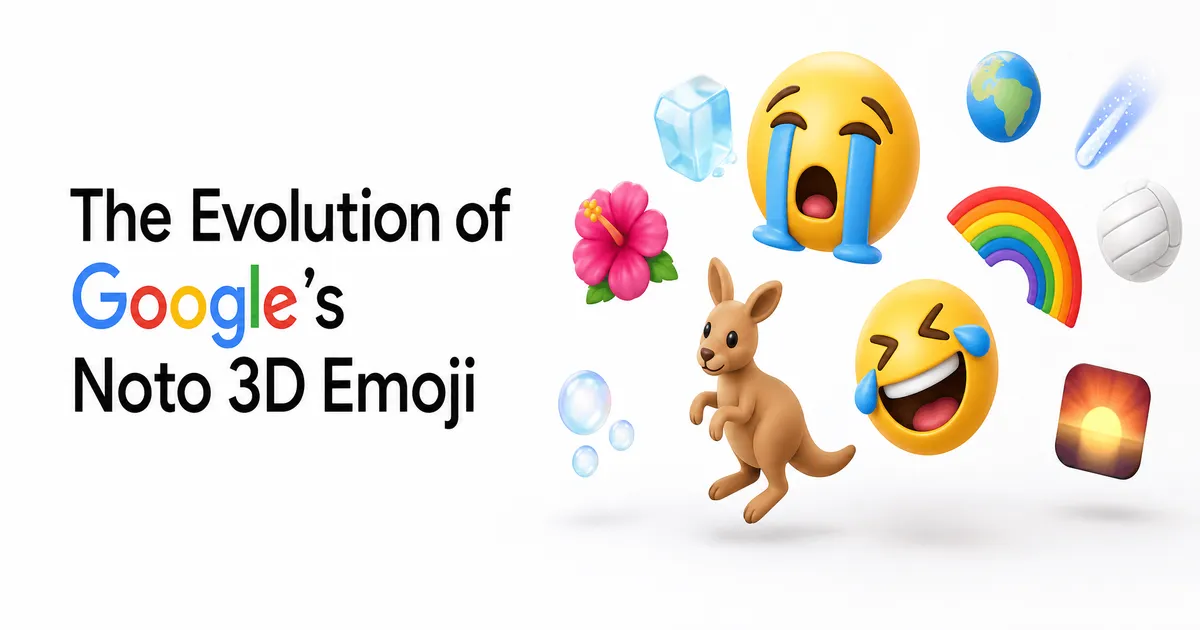
The Evolution of Google's Noto 3D Emoji: Design, Data, and AI
The way we use emoji has fundamentally changed. In the early days of digital communication, emoji were highly literal—users sent a nail polish emoji simply because they were getting their nails done. Today, emoji serve as a "language within the language," providing crucial subtext and breaking down the digital barriers of our screens. Led by Jennifer Daniel, Creative Director for Android and Pixel, Google reimagined its entire library of 3,977 emoji characters to meet the demands of modern expression. This massive update brings physical depth, emotional resonance, and improved accessibility to the Noto 3D emoji library.
Complete Redesign: Google transformed 3,977 emoji into 3D models to add physical and emotional depth.
Data-Driven Decisions: Shifting internet culture has moved users away from literal expressions toward hyperbole, drama, and overwhelm.
AI for Accessibility: An AI-powered contrast tool was utilized to ensure diverse skin tones remain visible in dark mode.
Open Source: Google released the raw
.OBJfiles for the entire Noto 3D portfolio, allowing the public to use them for VR worlds, apps, and memes.
Emoji are essential for keeping blunt digital messages from accidentally ruining a conversation's vibe. As human expression leans more toward hyperbole, the visual tools we use must evolve alongside us. Furthermore, touching a design element used by billions of people trillions of times a day requires immense care, making this evolution a vital case study in UX, accessibility, and modern communication.
How Digital Expression is Evolving
Modern internet culture has steadily migrated from mild emotional expressions to those of drama and overwhelm. Large-scale data from Gboard Federated Analytics highlights this behavioral shift.
For years, the "face with tears of joy" (😂) was the undisputed king of emoji. However, by 2025, it had slipped down the charts. Instead, users gravitated toward the loudly crying face (😭), which serves as a masterclass in modern vocabulary because it effectively captures both hilarity and devastating overwhelm. Similarly, the unhinged "rolling on the floor laughing" emoji (🤣) rose to the top for expressions of extreme laughter. Even heartbreak has evolved; data shows a poetic shift in popularity from the traditional broken heart (💔) to the wilted flower (🥀).
The Design Philosophy Behind 3D Emoji
Google's approach to moving emoji into a 3D future prioritizes expression over hyper-realism. Because the human brain processes emoji faster than text, designs must have a "pulse and a soul" rather than the cold, precise anatomical perfection found in industrial CAD models. For instance, while a real-life kangaroo can look terrifying, an illustrative 3D design can capture the animal's true, playful vibe.
Moving from flat pixels to a three-dimensional environment introduced unprecedented architectural questions for the design team. Designers had to conceptualize unseen elements, such as the back of a smiley face - debating whether it should function as a concave mask, a solid bouncy ball, or a flat piece of paper.
Insights from Large-Scale User Studies
To ensure the 3D transition didn't disrupt human connection, Google ran extensive user research, uncovering several universal design truths:
Users overwhelmingly prefer full-body animals over "floating heads".
Adding props to an emoji hurts user comprehension.
Tiny, seemingly harmless tweaks—like changing the direction of a wink—can shift an emoji's meaning from mild confusion to accidental outrage.
Enhancing Accessibility with AI
A major challenge in digital design is ensuring that emoji featuring the darkest skin tones remain visible in dark mode. To solve this, Google built an AI-powered contrast tool. This tool analyzes each emoji at the pixel level, flags areas where the contrast ratio is too low, and suggests high-contrast solutions. These AI-generated suggestions are then implemented by human designers, ensuring equitable accessibility for all users sending and receiving these characters.
Open-Source 3D Models for the Community
Language only lives when people find new ways to use it. Recognizing this, Google has made the entire Noto 3D portfolio completely open source. In an industry first, true 3D models of the emoji are available to the public. Google provides the raw .OBJ files to the community, encouraging users to stretch, break, and remix them to build immersive VR worlds, indie apps, or creative internet memes.
Best Practices for Emoji Design
Based on Google’s research and redesign process, here are the best practices for scalable icon design:
Prioritize Expression Over Realism: Avoid anatomical perfection if it sacrifices a playful vibe.
Ensure Dark Mode Contrast: Utilize pixel-level contrast analysis to make sure all skin tones are visible on dark backgrounds.
Keep It Simple: Avoid adding unnecessary props to characters, as they hinder quick comprehension.
Use Full Forms: Default to full-body designs (like whole animals) rather than isolated heads.
Common Mistakes
Ignoring Subtext: Assuming users want literal representations (e.g., nail polish) rather than emotional nuance.
Careless Tweaks: Failing to realize that minor changes, like the direction of a character's gaze or wink, can drastically alter the intended emotion.
Chasing CAD Perfection: Creating cold, hyper-realistic 3D models that lack a soul and fail to connect with users.
Practical Examples
The Shift to Overwhelm: Replacing a standard laugh (😂) with a loudly crying face (😭) to convey a mix of hilarity and absolute devastation.
The Playful Kangaroo: Using illustration to capture a kangaroo's fun essence rather than modeling its terrifying, hyper-realistic anatomy.
Expert Tips
When redesigning a universally used product, it is crucial to understand that the brain processes imagery faster than text. You cannot simply "slap on a design" and expect it to work; true innovation requires evaluating how changes impact fundamental human connection.
Frequently Asked Questions
How many emoji did Google redesign for Noto 3D? Google reimagined a total of 3,977 emoji characters for the Noto 3D update.
Why are emoji moving from 2D to 3D? Emoji are shifting to 3D to add physical and emotional depth to modern communication, helping characters feel more alive without relying on hyper-realism.
Can I use Google's 3D emoji for my own projects? Yes. The entire Noto 3D portfolio is open source, and Google provides the raw .OBJ files for the community to build VR worlds, apps, and memes.
How did Google make emoji accessible in dark mode? Google built an AI-powered contrast tool that analyzes emoji pixel-by-pixel, flagging low contrast ratios and suggesting solutions to ensure darker skin tones are clearly visible on dark screens.
Key Takeaways
Modern communication relies heavily on hyperbole and subtext, driving the popularity of dramatic emoji like 😭 and 🥀.
Google’s 3D designs prioritize a "pulse and a soul" over cold, photorealistic perfection.
Large-scale studies prove that users prefer full-body characters and that adding props hurts comprehension.
AI is a critical tool for solving accessibility issues, such as pixel contrast in dark mode.
Google's release of open-source
.OBJfiles empowers creators to evolve digital language further.
Conclusion
The evolution of Google's Noto 3D emoji library highlights a fundamental truth: language is meant to be shared and adapted. By combining large-scale user data, AI-driven accessibility tools, and a philosophy that prioritizes soulful expression over rigid realism, Google has successfully modernized a crucial aspect of digital communication. By releasing these 3D models to the open-source community, the language of emoji will continue to stretch into new, unforeseen shapes.
Samsung New Product - Samsung Music Studio Series in India: Complete Guide to Wi-Fi Speakers
Community Discussion
Loading comments...
Join the Conversation
Log in to post your thoughts, ask questions, and engage with authors and developers.
Log in to Comment