Grok 4.5: The Complete Guide to SpaceXAI’s Opus-Class Coding Agent Alternatives
Discover everything about SpaceXAI’s Grok 4.5. Explore pricing, context windows, benchmark performance, and how to use this Opus-class agent in Cursor.
Author
Shalimar Mehra
Grok 4.5: The Complete Guide to SpaceXAI’s Opus-Class Coding Agent
Introduction - On July 8, 2026, SpaceXAI (formerly xAI) shook the artificial intelligence landscape with the release of Grok 4.5. Built jointly with the AI coding startup Cursor—following SpaceX's $60 billion acquisition of the company—Grok 4.5 is a mixture-of-experts (MoE) frontier model tailored specifically for coding, agentic workflows, and complex knowledge work.
Pitched by Elon Musk as an "Opus-class model," Grok 4.5 aims to deliver top-tier reasoning while aggressively undercutting competitors on price and latency. Whether you are a software engineer building full-stack applications or a technical leader managing enterprise AI routing, understanding Grok 4.5's capabilities and constraints is essential for modern development.
Quick Answer / Summary - Grok 4.5 is SpaceXAI’s flagship 1.5-trillion parameter MoE model, featuring a 500,000-token context window. It boasts remarkable efficiency, operating at 80 tokens per second while using approximately 4.2 times fewer output tokens than Anthropic's Claude Opus 4.8 to complete software engineering tasks. Priced at $2 per million input tokens and $6 per million output tokens, it provides near-frontier intelligence at a fraction of the cost of its rivals.
Why It Matters - The release of Grok 4.5 signals a paradigm shift in the AI coding market: the transition from raw benchmark races to the "routing era". The defining metric for enterprise development teams is no longer just intelligence, but "cost per accepted change".
By co-training Grok 4.5 on trillions of tokens of real developer-agent interaction data from Cursor, SpaceXAI has built a model that understands the actual loop of software work—how developers inspect files, interpret failures, and use tools. This integration makes Grok 4.5 one of the most cost-efficient agents for production workloads.
Grok 4.5 Specs and Architecture:
Grok 4.5 departs from its predecessor, Grok 4.3, in several critical ways. It is a mixture-of-experts architecture trained jointly on SpaceXAI's infrastructure and Cursor's vast repository of developer-agent data.
Context Window: Grok 4.5 features a 500K-token context window. This is notably smaller than Grok 4.3's 1M-token window, meaning teams relying on massive contexts may need to strategize their routing.
Reasoning Capability: The model defaults to a "high" reasoning effort, meaning it spends more time computing before generating its first token, yielding stronger multi-step results. Users can configure effort levels between low, medium, and high.
Inputs and Outputs: Grok 4.5 accepts both text and image inputs, outputting text.
Speed: It serves tokens at a rapid 80 TPS (tokens per second), rivaling smaller, faster models.
Pricing and Token Efficiency:
Grok 4.5 fundamentally disrupts frontier model pricing.
Model | Input (per 1M tokens) | Output (per 1M tokens) | Cached Input (per 1M) |
|---|---|---|---|
Grok 4.5 | $2.00 | $6.00 | $0.50 |
Claude Opus 4.8 | $5.00 | $25.00 | N/A |
GPT-5.5 | $5.00 | $30.00 | N/A |
(Note: Pricing data verified at launch. Grok 4.5 also offers a fast variant priced at $4/M input and $18/M output.)
Beyond base pricing, Grok 4.5's true advantage lies in token efficiency. On the SWE-Bench Pro evaluation, Grok 4.5 used an average of 15,954 output tokens per task, roughly 4.2 times fewer than Opus 4.8, which consumed over 67,000 tokens for similar tasks. Independent testing by Artificial Analysis found that Grok 4.5 costs just $2.59 per coding task within the Grok Build harness, compared to $11.80 for Claude Fable 5.
Benchmark Performance:
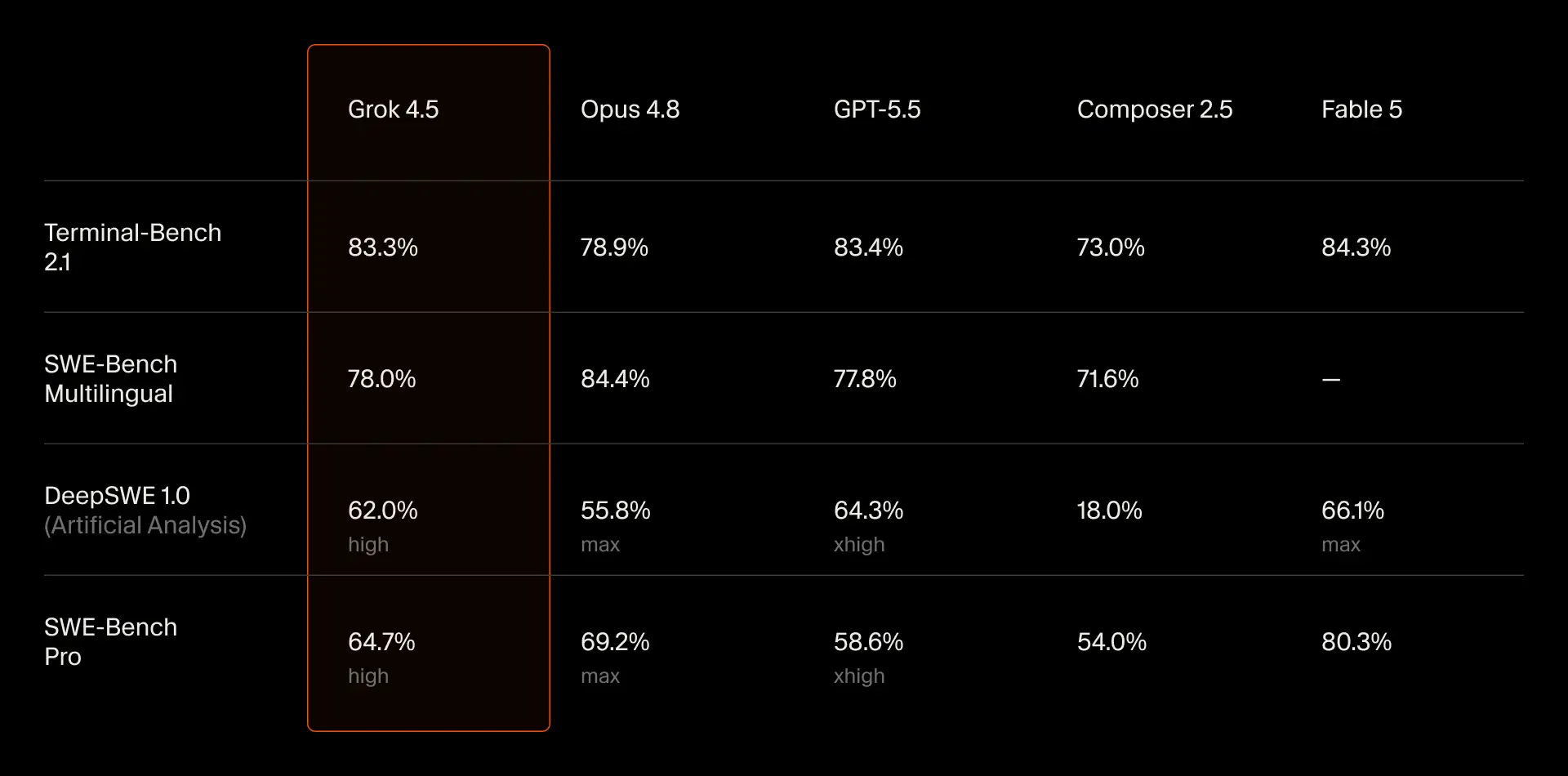
Grok 4.5 places highly on major third-party evaluations, though it does not outright dominate every category:
Artificial Analysis Intelligence Index: Scores 54, ranking #4 globally behind Claude Fable 5, GPT-5.5, and Claude Opus 4.8.
Coding Agent Index: Scores 76, placing it on par with GPT-5.5 in Codex.
Terminal-Bench 2.1: Scores 83.3%, edging out Opus 4.8 (78.9%) and rivaling Fable 5 (84.3%).
SWE-Bench Pro (Resolve Rate): Achieves 64.7%, trailing Opus 4.8 (69.2%) and Fable 5 (80.4%), but outperforming GPT-5.5 (58.6%).
Important Caveats:
Artificial Analysis noted a high hallucination rate (54%) for Grok 4.5 on its Omniscience Index, meaning verification of factual outputs remains necessary.
An early snapshot of Cursor's codebase was accidentally included in Grok 4.5's training data, potentially skewing internal CursorBench results, which were subsequently excluded from public comparisons.
Step-by-Step Guide: Using the Grok 4.5 API in Cursor
If you prefer to bring your own API key rather than using Cursor's internal model pool, follow these steps to integrate Grok 4.5:
Generate an API Key: Navigate to the SpaceXAI Console (console.x.ai) and create a new API key.
Open Cursor Settings: In the Cursor IDE, go to
Settings > Modelsand scroll down to theAPI Keyssection.Configure OpenAI Override: Expand the API Keys section. Because Cursor supports OpenAI-compatible endpoints, enter your Grok API key into the "OpenAI API Key" field.
Set the Base URL: Enable the "Override OpenAI Base URL" option and paste the Grok API URL.
Enable the Model: Ensure
grok-4.5is added and enabled in your Model settings.Start Coding: Open the Chat interface, select the Grok model, and begin your agentic workflow.
(Note: Currently, routing Grok through the OpenAI base URL means you cannot use ChatGPT and Grok simultaneously without manually swapping keys.)
Best Practices:
Implement Model Routing: Do not use Grok 4.5 for every single task. Use a smaller, faster model for routine maintenance (like documentation updates), and route complex implementations or multi-file architectural changes to Grok 4.5.
Utilize Prompt Caching: When building directly with the SpaceXAI API, always set a
prompt_cache_key. This routes your conversation to the same server, ensuring you receive the 75% cached-input discount ($0.50/M tokens).Leverage Office Add-ins: Grok 4.5 is highly proficient at general knowledge work. It is the default model in Grok Build and features robust integrations for Microsoft Word, Excel, and PowerPoint.
Common Mistakes:
Ignoring the Hallucination Rate: Grok 4.5's increased intelligence comes with a higher confidence in incorrect information (a 54% hallucination rate on specific omniscience tests). Always use human review for highly factual or security-critical code.
Assuming Global Availability: At launch, Grok 4.5 was not available in the EU due to regulatory hurdles, with access expected to open in mid-July 2026. Some users successfully bypassed this restriction using a VPN, but official enterprise support may vary.
Practical Examples
End-to-End App Generation Grok 4.5 excels at creating functional applications with a single prompt. For example, when prompted to "Make a beautiful simulation of the universe and solar system... use threejs", the model generated a fully functional, 3D interactive application with adjustable time acceleration and accurate orbital mechanics without requiring follow-up corrections.
Agentic Terminal Use When evaluating complex race condition bugs, Grok 4.5 effectively utilizes terminal tool-calling to navigate repositories, isolate the error, and execute test cases, successfully solving bugs where other frontier models fail.
Expert Tips
Track "Cost Per Accepted Change" Token pricing can be deceptive. An inexpensive model that hallucinates noisy diffs will cost your team in manual review and CI/CD time. Evaluate Grok 4.5 based on its holistic cost: token usage + retry counts + human review time. According to evaluations, Grok 4.5 shines here due to its low output token usage per task.
Frequently Asked Questions
Is Grok 4.5 available in the EU? No, at its July 2026 launch, Grok 4.5 was region-locked out of the EU. SpaceXAI expects full EU availability by mid-July.
How much does Grok 4.5 cost? The base model costs $2.00 per million input tokens and $6.00 per million output tokens, with cached inputs heavily discounted to $0.50 per million.
What is the context window for Grok 4.5? Grok 4.5 features a 500,000-token context window.
Does Grok 4.5 beat Claude Opus 4.8? On raw coding benchmarks like SWE-Bench Pro, Opus 4.8 slightly outperforms Grok 4.5. However, Grok 4.5 wins heavily on token efficiency, generating answers using roughly 4.2x fewer tokens, making it vastly more cost-effective per task.
Key Takeaways
Cost-Effective Frontier Intelligence: Grok 4.5 offers Opus-class capabilities at roughly a quarter of the output price of its main competitors.
Optimized for Agents: Trained jointly with Cursor, the model uniquely understands real-world developer workflows and terminal interactions.
Efficiency over Raw Scores: While it doesn't top every benchmark leaderboard, its 80 TPS speed and low token consumption make it a highly practical choice for enterprise engineering teams.
Conclusion
Grok 4.5 proves that the AI coding race is no longer just about who can build the largest model, but who can build the most practical one. By leveraging Cursor's real-world IDE data and optimizing for agentic tool use, SpaceXAI has delivered a model that dramatically lowers the cost of automated software engineering. While teams requiring massive contexts or zero-hallucination factual reliability may still lean toward Claude Opus, Grok 4.5 firmly establishes itself as a must-have routing option for fast, efficient, and complex knowledge work.
Must Read: Cursor Launches Native iOS App for AI-Assisted Coding
Community Discussion
Loading comments...
Join the Conversation
Log in to post your thoughts, ask questions, and engage with authors and developers.
Log in to Comment