React Frameworks in 2026: The Ultimate Comparison & Production Guide
Discover the top React frameworks in 2026. Compare Next.js, Remix, Astro, and TanStack Start for performance, enterprise readiness, and SEO.
Author
Shalimar Mehra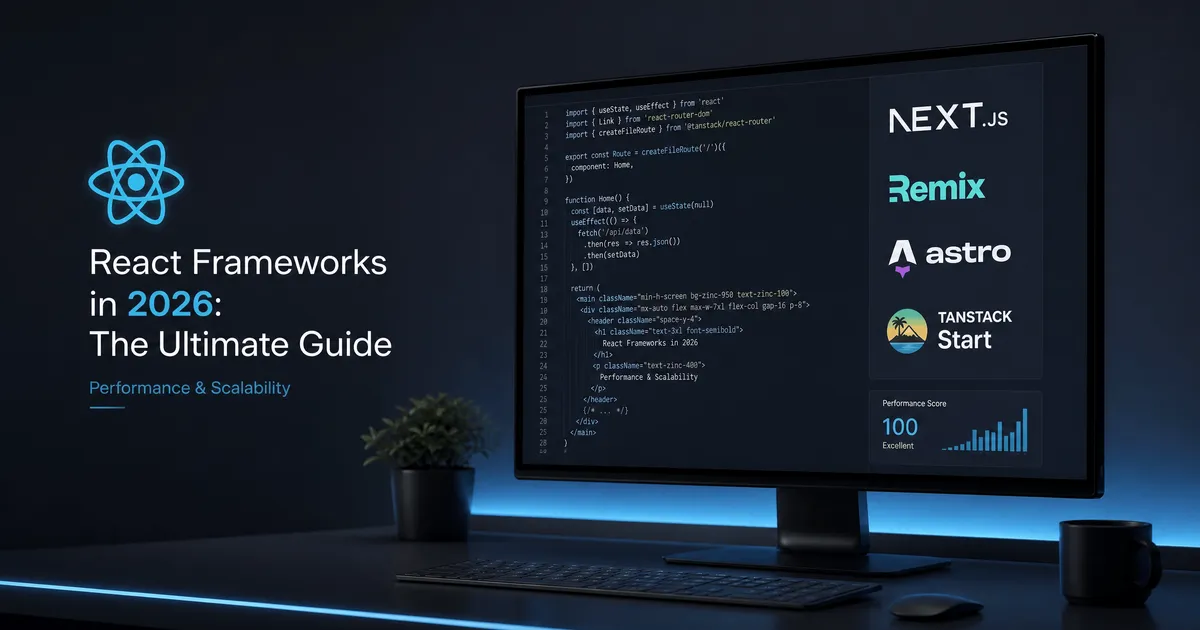
React Frameworks in 2026: The Ultimate Comparison & Production Guide
Introduction - The JavaScript framework landscape has shifted dramatically in 2026. React is no longer just a UI library; it has evolved into a comprehensive architectural platform powered by React 19, React Server Components (RSC), and the React Compiler. With React maintaining a dominant 69.74% global market share among JavaScript frameworks, the "framework wars" have largely settled. The critical decision for engineering teams is no longer whether to use React, but which React meta-framework best aligns with their performance requirements, team expertise, and infrastructure.
Quick Answer / Summary - If you are starting a new project in 2026, here is the executive summary of the framework landscape:
Next.js 15/16: The enterprise standard (67% market share). Best for complex, data-intensive SaaS applications requiring robust ecosystems and hybrid rendering.
Remix (React Router v7): The web standards champion. Best for data-mutation-heavy applications, e-commerce, and edge-first deployments.
Astro 5+: The performance king. Acquired by Cloudflare in 2026, it ships zero-JS by default, making it the premier choice for content sites and marketing pages.
TanStack Start: The rising star. Offers explicit server functions and highly typed routing with a leaner runtime, building significantly faster than Next.js.
Why It Matters - Choosing the wrong framework in 2026 carries a steep price. Technical debt from outdated client-side rendering (CSR) paradigms directly threatens SEO rankings and conversion rates due to poor Core Web Vitals, like Interaction to Next Paint (INP). Framework selection dictates your bundle size, your server costs, your developer velocity, and ultimately, your user experience.
1. The State of React in 2026
React 19 is now an enterprise-ready standard, adopted by 48.2% of the ecosystem. Three major paradigm shifts define modern React development:
The React Compiler: Reaching version 1.0 in late 2025, the compiler eliminates the need for manual memoization (
useMemo,useCallback). It automates performance tuning, resulting in cleaner code and faster interactions.React Server Components (RSC): RSC is the default architecture. It shifts data fetching to the server, shipping zero component JavaScript to the browser for static parts of the UI.
AI-Native Development: As of 2026, 42% of committed code is generated by AI tools, projected to hit 65% by 2027. React's massive footprint makes it the most fluent language for AI coding assistants.
2. Next.js 15+: The Enterprise Heavyweight
Next.js remains the undisputed market leader, powering roughly 2.6% of the entire internet and commanding 67% of new enterprise React projects.
Strengths: Next.js offers unmatched hybrid rendering (SSR, SSG, ISR, and Partial Prerendering). It integrates deeply with Vercel and features Turbopack for ultra-fast local builds.
Weaknesses: Next.js has faced declining developer satisfaction due to the complexity of the App Router, frequent breaking changes, and a steep learning curve. Benchmarks show that its RSC architecture can suffer under heavy load without caching; a 2026 load test revealed Next.js handling 701 req/s compared to TanStack Start's 2,357 req/s under identical constraints. Furthermore, Next.js ships heavier JavaScript bundles (~193KB) compared to leaner frameworks.
3. Remix (React Router v7): The Web Standards Champion
In late 2024, Remix officially merged into React Router v7, consolidating its loader/action architecture into the broader React ecosystem.
Strengths: Remix relies on progressive enhancement, meaning forms and mutations work seamlessly even before JavaScript loads. It excels on edge networks like Cloudflare Workers, achieving up to 30% faster Time to First Byte (TTFB) compared to Next.js.
Weaknesses: It has a smaller third-party ecosystem compared to Next.js and requires more manual configuration for serverless deployments.
4. Astro 5+: The Performance Champion
Astro is the fastest-growing meta-framework, ranking #1 in developer satisfaction in the State of JS 2025 survey. Following its acquisition by Cloudflare in January 2026, Astro is now a serious enterprise choice.
Strengths: Astro's "Islands Architecture" ships zero JavaScript by default. It delivers Largest Contentful Paint (LCP) metrics 40–70% faster than Next.js. It is framework-agnostic, allowing developers to mix React, Vue, or vanilla JS components.
Weaknesses: It is not designed for highly interactive Single Page Applications (SPAs) and requires complex setups for deep state-driven sessions.
5. TanStack Start: The Rising Contender
Weekly npm downloads for TanStack Start surged to 14 million by mid-2026. TanStack Start treats the client as the owner of the component tree, utilizing explicit createServerFn Remote Procedure Calls (RPCs) rather than defaulting to Server Components.
Strengths: Extremely fast build times (powered by Vite 8 and Rolldown) and 40% smaller client JavaScript bundles compared to Next.js. It provides end-to-end type safety directly into the routing layer.
Weaknesses: The RSC layer is still in early development compared to Next.js, and error messages across environment boundaries can be cryptic.
E-Commerce Showdown: Shopify Hydrogen vs. Next.js Commerce
For headless e-commerce, the choice often narrows down to Shopify Hydrogen and Next.js Commerce.
Shopify Hydrogen: Built on Remix/React Router v7 conventions and hosted on Shopify Oxygen. It is the best choice if you are committed to Shopify Plus, as it bundles hosting costs and offers sub-20ms latency to the Storefront API.
Next.js Commerce: Highly composable and flexible. It is ideal if you need a multi-vendor setup (e.g., combining BigCommerce, Sanity CMS, and custom edge logic) or if your team is already standardized on Next.js.
Best Practices
Strict Client/Server Boundaries: Push the
'use client'directive as far down your component tree as possible. Making a top-level component a client component forces all children to hydrate, destroying the bundle-size benefits of RSC.Use TypeScript: Typed codebases significantly reduce hallucinations when using AI coding assistants. TypeScript is a strict requirement for 72% of modern front-end roles.
Modern State Management: Shift client UI state management to Zustand. In 2026, Zustand commands 35% adoption and executes state updates nearly twice as fast as Redux.
Embrace Incremental Adoption: Do not rewrite your entire application to use Server Components at once. Start by migrating static, data-heavy routes (like product lists and blogs) to the server.
Common Mistakes
Over-Caching in Next.js: Developers often struggle with the Next.js Router Cache. The client-side cache does not always clear immediately after a mutation (like
revalidatePath), leading to stale data on backward navigation.Failing to Optimize RSC Payloads: The Flight protocol sends data to the client in a specific serialization format. Passing excessively large objects as props from Server to Client Components creates a "double data problem," bloats the HTML response, and increases parsing overhead.
Clinging to Legacy Tooling: Create React App (deprecated in 2025) and Gatsby (in managed decline) are dead ends. New projects should standardize on Vite or Turbopack-based frameworks.
Practical Examples
Scenario A: High-Traffic Content Publishing
Stack: Astro + Sanity CMS.
Result: Astro’s zero-JS default ensures a Lighthouse score of 99 out of the box, slashing TTFB to 100-200ms and outperforming Next.js by up to 70% in LCP metrics.
Scenario B: Complex B2B SaaS Dashboard
Stack: Next.js + Tailwind CSS + Zustand.
Result: Deep integration of Server Components allows direct ORM queries from the UI, cutting API boilerplate by 40%. The App Router efficiently manages complex nested layouts and nested loading states.
Expert Tips
Avoid Waterfall Requests: In Server Components, leverage
Promise.all()to fetch data concurrently, or use the new React 19use()hook to stream promises directly into the render tree without blocking the initial paint.Preserve Dashboard State: Use React 19.2’s new
<Activity>component. It allows you to pre-render and hide parts of the UI, preserving scroll position and state for complex tabbed dashboards without burning CPU cycles.
Frequently Asked Questions
Is React a framework or a library? React is technically a JavaScript library focused purely on rendering the view layer. It lacks built-in routing, server-side rendering, and data fetching, which is why developers pair it with meta-frameworks like Next.js, Remix, or Astro.
What is the difference between React Server Components (RSC) and SSR? Server-Side Rendering (SSR) generates initial HTML on the server but still ships the full JavaScript bundle to the client for hydration. RSCs run exclusively on the server, sending serialized UI output without adding a single byte to the client JavaScript bundle.
Should I migrate from Next.js to Astro? If your application is content-heavy (e.g., blogs, marketing pages, documentation) and performance/SEO is your top priority, yes. If you require complex, highly interactive, state-driven user sessions, stick with Next.js or TanStack Start.
Is Gatsby dead in 2026? Yes. Gatsby is considered legacy tech and is in managed decline following Netlify's core team layoffs. New projects should avoid Gatsby entirely.
Key Takeaways
Next.js is the safest enterprise bet for complex, dynamic applications.
Astro is the absolute winner for content-driven SEO sites, offering unbeatable LCP and TTFB metrics.
Remix (React Router v7) is the best choice for edge deployments and form-heavy progressive enhancement.
React 19 has changed the game by automating performance optimization via the React Compiler and making Server Components the default architecture.
Stunning Loaders - Top Websites to Find Stunning Loaders for Your Web Projects
Community Discussion
Loading comments...
Join the Conversation
Log in to post your thoughts, ask questions, and engage with authors and developers.
Log in to Comment