Claude for Teachers: The Complete Guide to Anthropic's Free K-12 AI Tool
Discover Anthropic's Claude for Teachers. Learn how verified US K-12 educators get free access to standards-aligned lesson planning, grading tools, and FERPA-compliant privacy.
Author
Shalimar Mehra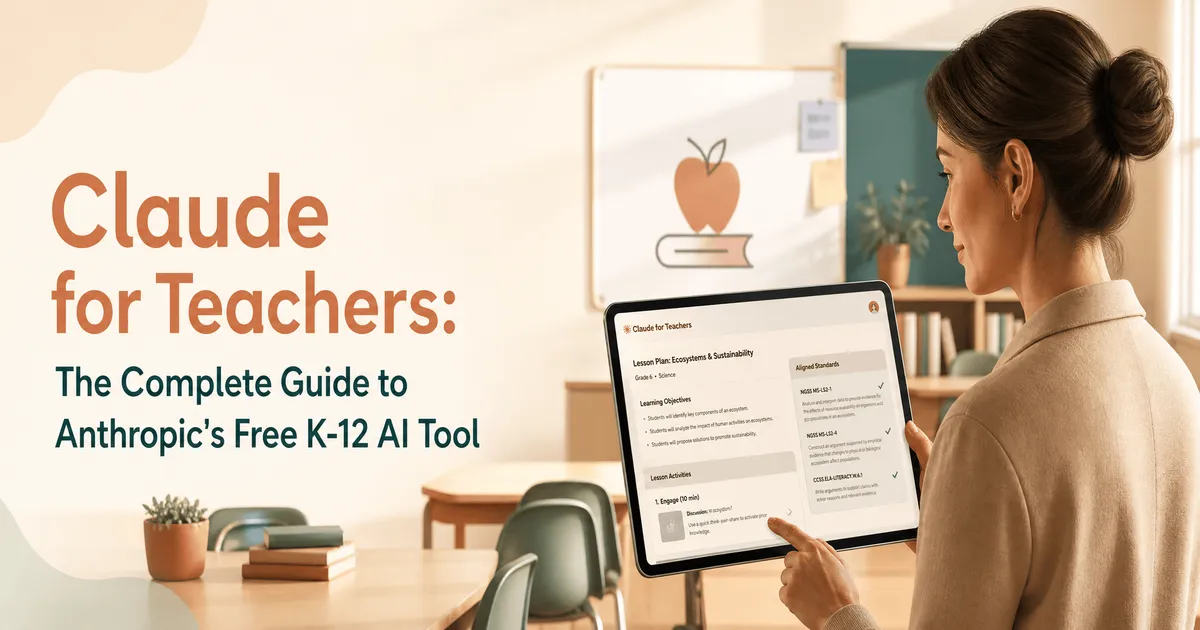
Claude for Teachers: The Complete Guide to Anthropic's Free K-12 AI Tool
Decades of educational research show that targeted practices like mastery-based learning, small group instruction, and individualized differentiation reliably boost student achievement. However, educators frequently lack the time and resources to implement these practices effectively. To help bridge the gap between educational best practices and a teacher’s limited schedule, Anthropic has launched Claude for Teachers. This tool is designed to protect what educators value most: direct time with their students.
Claude for Teachers is a free platform available to verified K-12 educators in the United States. It provides premium access to Claude’s artificial intelligence capabilities, alongside a library of teaching skills and direct connections to evidence-based curricula mapped to academic standards across all 50 states. Eligible educators can sign up by June 30, 2027, to receive a full year of free access.
Teachers often face stretched budgets, large class sizes, and planning demands that spill into their evenings, with this strain falling heaviest on under-resourced schools. While the impact of AI tools used directly by students can be mixed, early evidence suggests that AI tools built specifically for teachers can significantly strengthen instructional practices and improve student outcomes. Claude for Teachers addresses this by automating administrative tasks and scaffolded lesson planning, effectively closing the gap between what is ideal for students and what is possible in a teacher's workweek.
Grounded in Evidence-Based Curricula
One of the core features of Claude for Teachers is its direct integration with Learning Commons, which provides the AI with access to academic standards in all 50 U.S. states.
When Claude drafts a lesson plan, it does not just guess; it understands the smaller learning competencies beneath each standard and the chronological order in which students typically learn them. Furthermore, the platform integrates seamlessly with trusted, high-quality curricular resources like OpenSciEd and Illustrative Mathematics (IM v.360).
Automating Workflows with Claude Code and Cowork
Claude for Teachers includes features known as Claude Code and Cowork, allowing the AI to carry tasks forward on its own. This brings powerful automation directly to the educator's desk:
Data Analysis: Teachers can provide Claude with a folder of roster data, diagnostic scores, attendance, and personal notes. Claude will build a clear picture of each student's current standing, helping the teacher tailor instruction.
Scheduled Automation: Educators can delegate repeated tasks. For example, a teacher can set Claude to review exit tickets every school day at 4 PM, assessing student mastery and adapting the following day's lesson plan while the teacher drives home.
K-12 Ecosystem Integrations
Claude can connect across an expansive ecosystem of popular K-12 EdTech tools to simplify material creation.
Tool | Integration Purpose |
|---|---|
Generates auto-scored, standards-aligned math problems for practice and assessment. | |
Creates interactive activities and standards-aligned lessons in seconds. | |
Turns lesson materials into interactive, classroom-ready designs. | |
Builds high-quality math diagrams grounded in K-12 curricula. | |
Adapts and creates instructional materials for all students. | |
Generates diagnostic questions in English and Spanish to reveal student thinking. | |
Prepares instructional content to be classroom-ready. | |
Provides actionable insights about classes, assignments, and student progress. | |
Delivers personalized instructional feedback based on real classroom talk. |
Gold-Standard Data Privacy
Anthropic explicitly designed Claude for Teachers to prioritize K-12 student and educator privacy.
No Model Training: Data provided to Claude for Teachers is never used for AI model training purposes.
FERPA Compliance: Student information is rigorously protected under a K-12 Data Processing Addendum written to comply with the Family Educational Rights and Privacy Act (FERPA).
AFT Partnership: Anthropic collaborated with the American Federation of Teachers (AFT) to align their terms of service with the organization's "Gold Standard" for safety and privacy in K-12 education.
(Note: How educational data may be utilized in Claude for Teachers is ultimately governed by individual district and state policies.)
Step-by-Step Guide: How to Get Started
Verify Eligibility: Ensure you are a K-12 educator located in the United States. Claude for Teachers enforces an 18-and-over policy.
Sign Up for Access: Register before June 30, 2027, to lock in a full year of entirely free access.
Complete AI Fluency Training (Optional but Recommended): Access the free "AI Fluency for PK-12 Teachers" course, co-created by Anthropic and Teach For America, to learn how to responsibly use AI for classroom tasks.
Connect Your Tools: Link your account to the Learning Commons connector and your preferred K-12 ecosystem tools (like Canva or Diffit) to start generating standards-aligned materials.
Best Practices
Utilize Fine-Grained Prompting: When asking for a lesson plan, explicitly ask Claude to draw on state standards and fine-grained learning progressions to get the most accurate, scaffolded materials.
Control Your Data: Take advantage of the data analysis tools by sharing only what you feel comfortable with; you control exactly what data is shared with the platform.
Common Mistakes
Assuming District-Wide Deployment: Currently, Claude for Teachers is designed for individual educators only. A dedicated offering for schools and districts is coming soon. In the interim, interested districts are advised to use Claude for Nonprofits.
Ignoring State Policies: Do not assume all data can be freely uploaded. Always cross-reference your specific district and state data policies before sharing student diagnostics or rosters with the AI.
Practical Examples
Scenario 1: Differentiating a Lesson Plan A teacher introduces a new reading concept but has students at wildly varying readiness levels. The teacher asks Claude to adapt the primary materials. Claude instantly builds a differentiation plan and generates personalized, student-facing materials for each proficiency level—providing scaffolds for those who need access and further challenges for advanced learners.
Expert Tips
To maximize the tool's effectiveness, explore the open-source repository of teaching skills that Anthropic has released to the public. These skills were co-developed with Learning Commons, evaluated for pedagogical rigor and classroom usability, and refined using direct feedback from classroom teachers.
Frequently Asked Questions
How much does Claude for Teachers cost? It is entirely free for verified K-12 educators in the U.S. who sign up by June 30, 2027, granting them a full year of access.
Is student data used to train the AI? No. Data uploaded to Claude for Teachers is explicitly excluded from model training purposes.
Can my entire school district sign up? Not currently. The platform is currently available for individual educators, though a dedicated school and district offering is in development. Districts can utilize Claude for Nonprofits in the meantime.
Key Takeaways
Claude for Teachers provides verified U.S. K-12 educators with free, premium AI tools to streamline instructional planning.
The platform aligns directly with 50-state academic standards via Learning Commons.
It integrates seamlessly with a massive ecosystem of EdTech tools, including Canva Education, Diffit, and MagicSchool.
Educators can schedule recurring tasks, like analyzing daily exit tickets at 4 PM, without compromising FERPA compliance or student data privacy.
Conclusion
By combining premium AI capabilities with rigorous educational standards and strict data privacy, Claude for Teachers addresses the systemic lack of time and resources facing today's educators. It empowers teachers to implement evidence-based, differentiated learning strategies efficiently, allowing them to focus on the human relationships that remain at the heart of learning.
Original Source - Claude for teachers.
Google Spark - What is Gemini Spark? Google’s 24/7 AI Agent Explained
Community Discussion
Loading comments...
Join the Conversation
Log in to post your thoughts, ask questions, and engage with authors and developers.
Log in to Comment