Google SynthID Explained (2026): How AI Watermarking Works Across Text, Images, Audio & Video
Google SynthID is an advanced AI watermarking technology that helps identify AI-generated text, images, audio, and video. Learn how SynthID works, how it compares to C2PA, its strengths, limitations, and why it matters in 2026.
Author
Shalimar Mehra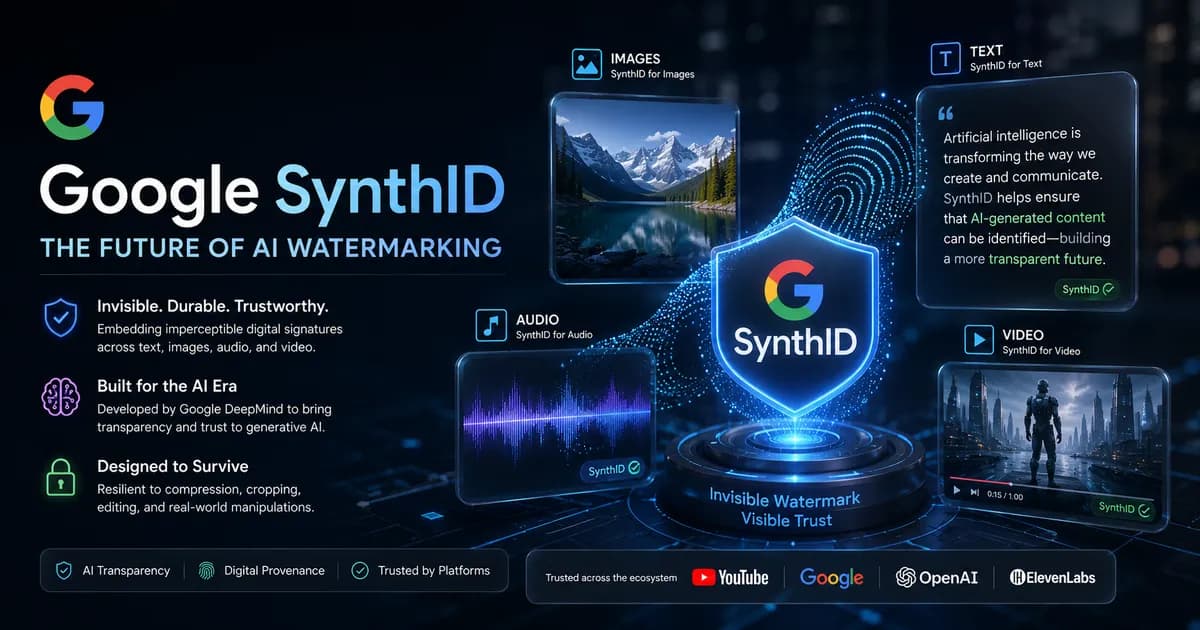
The Ultimate Guide to Google SynthID: How AI Watermarking Works in 2026
As artificial intelligence generates increasingly realistic text, images, audio, and video, distinguishing between human and machine-created content has become a critical global challenge. To address this, Google DeepMind developed SynthID, a state-of-the-art AI watermarking tool designed to embed imperceptible digital signatures directly into AI-generated media.
This comprehensive guide covers everything you need to know about Google SynthID, how it works across different media formats, its limitations, and how it compares to other standards like C2PA in the evolving landscape of AI governance.
What is Google SynthID?
Google SynthID is a watermarking framework that injects invisible and inaudible signals into AI-generated content. Unlike traditional visible watermarks (like logos or text overlays) that can be easily cropped or edited out, SynthID embeds its signature directly into the fundamental structure of the content—such as the pixels of an image or the token probability of text.
SynthID is integrated across Google's generative AI ecosystem, including:
Gemini for text generation.
Imagen for photorealistic image generation.
Lyria for high-fidelity music and audio.
Veo for cinematic video generation.
Furthermore, companies like OpenAI, Kakao, and ElevenLabs have begun incorporating SynthID into their own products, establishing it as a highly influential tool for digital provenance.
How Does Google SynthID Work?
SynthID's technical approach adapts specifically to the medium it is watermarking.
1. SynthID for Images and Video
For visual media, SynthID uses two neural networks that are co-trained in an adversarial loop: an embedder and a detector.
The Embedder: Subtly modifies individual pixel color values across the image in a holographically distributed pattern that the human eye cannot perceive.
Robustness: Because the watermark is woven throughout the image or video frames, it is highly durable. It survives common manipulations like JPEG compression, color filtering, rotation, minor cropping, and taking screenshots. Every frame in a video receives this treatment, making it resilient to trimming.
2. SynthID for Text
Text watermarking is arguably the most complex because it relies on statistical probability rather than pixels. SynthID Text uses a mechanism called Tournament Sampling.
Probability Tweaking: Large Language Models (LLMs) predict the next word (or token) based on probability scores. SynthID utilizes a cryptographic secret key to assign pseudorandom "g-values" to tokens, essentially placing words on a "green list" (slightly favored) or a "red list" (slightly suppressed).
Invisible Patterns: These probability adjustments are tiny (often just 2-3%) and do not alter the meaning, quality, or creativity of the generated text.
Detection Requirements: To build a statistically significant pattern, the text typically needs to be at least 200 words long. On shorter texts, the watermark is much harder to verify.
3. SynthID for Audio
For audio generated by Lyria, SynthID converts the audio waveform into a spectrogram (a visual representation of sound frequencies over time). It embeds the watermark into the spectrogram before reconstructing the audio. The resulting watermark is completely inaudible to human ears but can survive MP3 compression and standard audio processing.
SynthID vs. C2PA Metadata: Which is Better?
When discussing AI detection, SynthID and C2PA (Coalition for Content Provenance and Authenticity) are the two leading technologies. However, they work in fundamentally opposite ways.
Where the Data Lives: SynthID modifies the actual content (pixels, text structure, audio waves), while C2PA attaches a digital certificate (Content Credentials) to the file's metadata.
Durability: C2PA metadata provides a comprehensive editing history and cryptographic proof of origin, but it is easily stripped if a user re-saves the file, posts it to certain social media sites, or simply takes a screenshot. SynthID, on the other hand, is designed to survive screenshots and file format changes.
The Best Approach: The two systems are highly complementary. In fact, platforms like YouTube and Google Search use both simultaneously. C2PA provides rich contextual metadata, while SynthID acts as a durable fallback signal if the metadata is lost or stripped.
How to Detect SynthID Watermarks
Google has rolled out several ways for users, developers, and platforms to detect SynthID watermarks:
Gemini App Verification: Users can upload an image, video, or audio file directly to the Gemini app and ask, "Was this created by AI?" Gemini will scan for the SynthID watermark and C2PA credentials to provide an answer.
YouTube Auto-Labeling: Starting in 2026, YouTube automatically detects and labels videos containing significant photorealistic AI content using SynthID and C2PA signals, shifting away from voluntary creator disclosure.
Google Search and Chrome: Users can right-click an image or use "Circle to Search" to check if content contains SynthID or C2PA markers.
Open-Source Detectors: Google has open-sourced SynthID Text via Hugging Face. Developers can use a Bayesian detector to score text and determine the likelihood of it being watermarked.
Limitations and Vulnerabilities
While SynthID is a massive leap forward for AI transparency, it is not entirely foolproof.
Vulnerability to Editing: Heavy rewriting, paraphrasing, or translating text via tools like Google Translate can strip the SynthID Text watermark. For audio, extreme manipulations like severe pitch-shifting or time-stretching can degrade the signal.
Adversarial Attacks: Researchers have found ways to defeat SynthID. A universal attack tool known as UnMarker has been shown to reduce SynthID image detection from nearly 100% to just 21%. Furthermore, researchers have demonstrated "layer inflation attacks" that can trick the text detection algorithm, and $50 API spoofing attacks that can statistically reverse-engineer the watermark pattern.
Not a Universal Deepfake Detector: SynthID only detects content generated by models that have SynthID actively enabled. It cannot tell you if an image was generated by an unwatermarked model (like basic Stable Diffusion) or if a photograph is real; it can only tell you if its own watermark is present.
Legal, Ethical, and Governance Implications
With regulations like the EU AI Act (Article 50) entering full enforcement in 2026, generative AI companies are legally required to ensure transparency. The EU mandates a "multilayered approach" to AI content, requiring both metadata (like C2PA) and imperceptible watermarks (like SynthID) to be applied at the point of creation.
However, experts warn that watermarking alone without standardized, global enforcement is not enough for proper AI governance. The fragmentation of proprietary systems—with Google using SynthID, Meta using AudioSeal, and others using their own tools—makes universal detection incredibly difficult.
Conclusion
Google SynthID represents one of the most advanced, production-ready solutions for tracking the provenance of AI-generated content. By embedding durable, invisible signals into images, video, text, and audio, it provides a crucial layer of transparency in a world increasingly filled with synthetic media. While adversarial attacks and a lack of universal industry standards highlight that the technology is not a silver bullet, SynthID remains a foundational pillar for the future of responsible AI development.
Also Read this: Google Gemini’s 2026 Canva & Adobe Integrations: Redefining AI Design
Community Discussion
Loading comments...
Join the Conversation
Log in to post your thoughts, ask questions, and engage with authors and developers.
Log in to Comment