How to Scale Generative Media Workflows with Nano Banana 2 Lite and Gemini Omni Flash
Discover how to build and scale interactive, multimodal AI applications using Google's ultra-fast Nano Banana 2 Lite image model and Gemini Omni Flash for conversational video editing.
Author
Shalimar Mehra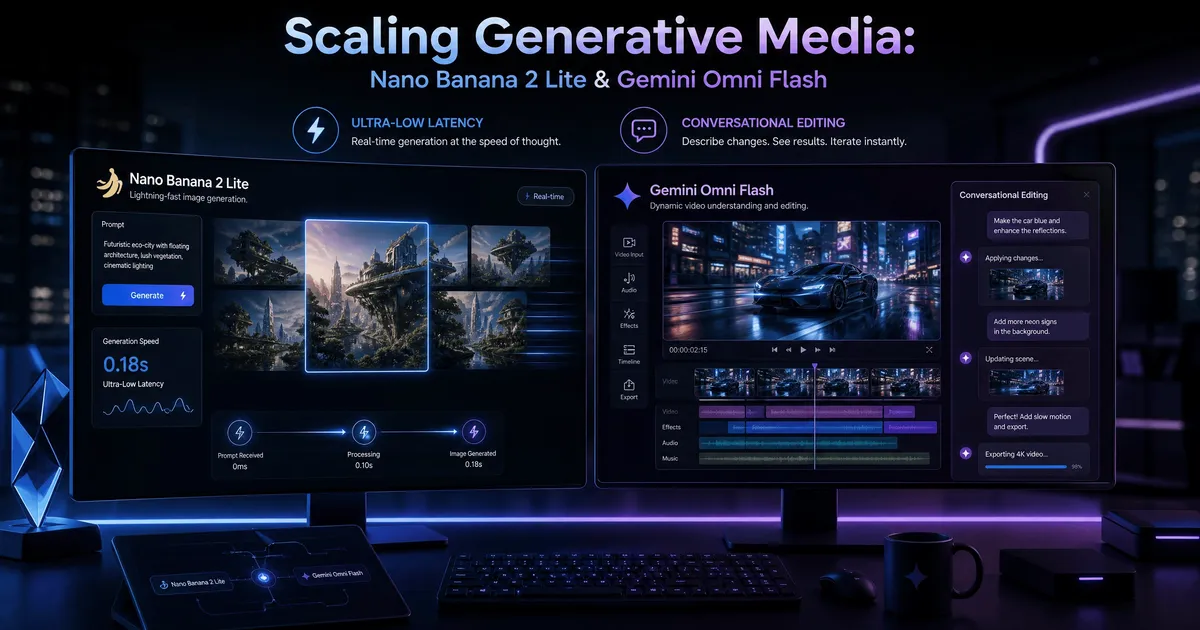
How to Scale Generative Media Workflows with Nano Banana 2 Lite and Gemini Omni Flash
The demand for high-quality, real-time generative media is accelerating. Developers and creators are increasingly seeking tools that not only produce exceptional visual content but also operate at high speeds and lower costs. To meet this need, Google has introduced two powerful new models to its generative AI lineup: Nano Banana 2 Lite and Gemini Omni Flash.
By chaining these two models together, developers can build comprehensive, end-to-end multimedia experiences that seamlessly connect rapid image generation with sophisticated video creation. Here is a comprehensive guide to leveraging these new tools to build next-generation applications.
Credits - Google Blogs
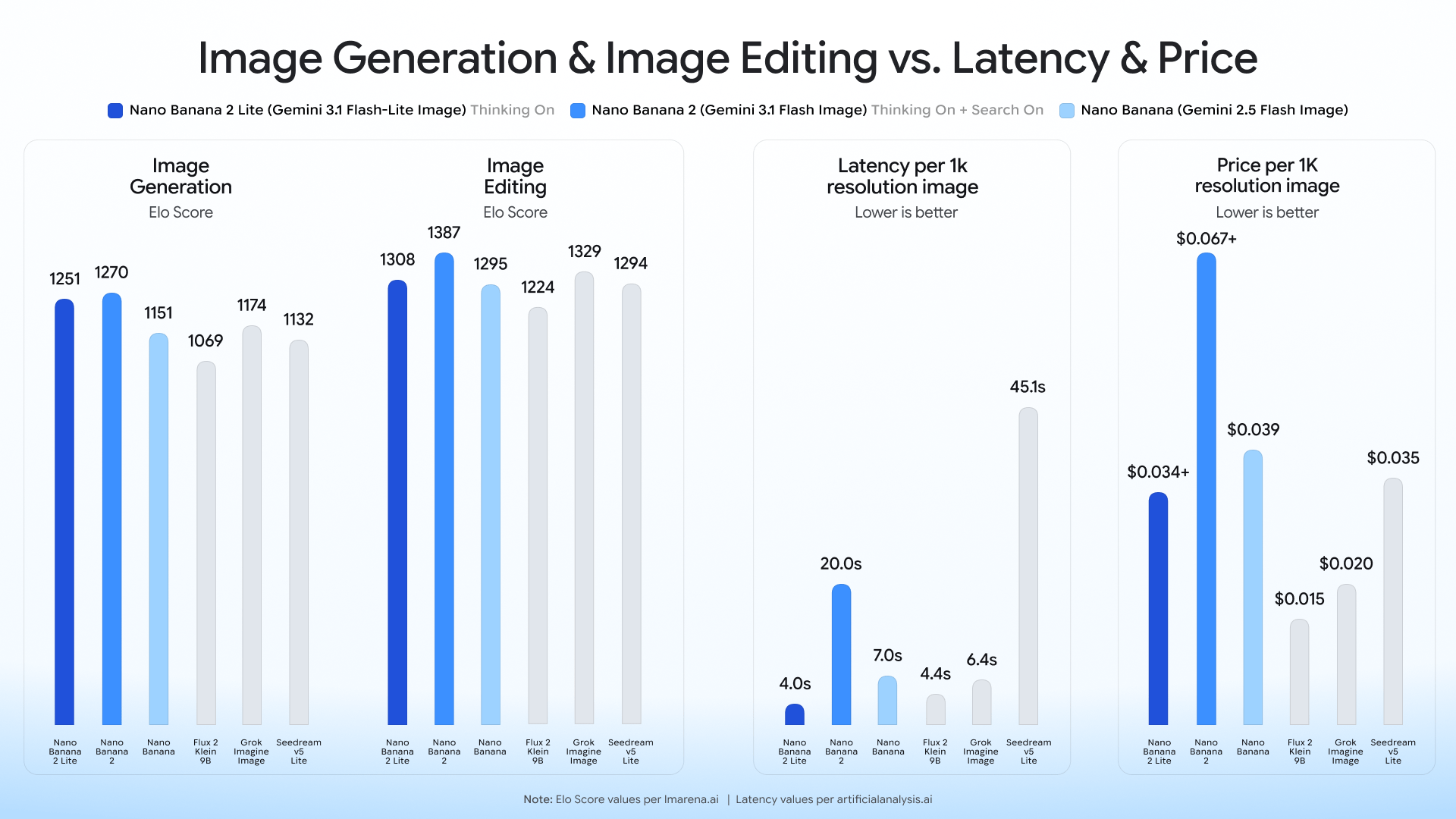
Performance benchmarks for Nano Banana 2 and 2 Lite compared to competitor AI image models, evaluating trade-offs between generation/editing quality (Elo scores), processing latency and cost per 1K-resolution image.
Accelerating Ideation with Nano Banana 2 Lite
When building high-velocity developer pipelines, speed and cost are critical constraints. Nano Banana 2 Lite (gemini-3.1-flash-lite-image) is designed specifically for rapid ideation and high-throughput environments. It serves as the fastest and most cost-efficient image model in the Nano Banana family.
Key Performance Advantages:
Ultra-Low Latency: The model delivers text-to-image outputs in just 4 seconds, making it the perfect engine for interactive prototyping and rapid visual drafting.
Cost-Efficiency: Priced at $0.034 per 1K-resolution image, it allows developers to manage operational budgets effectively, especially when applications require generating thousands of images.
Quality Retention: Despite the focus on speed, Nano Banana 2 Lite retains strong prompt adherence, reliable character consistency, and legible in-image text rendering.
For developers currently utilizing the legacy first-generation Nano Banana (gemini-2.5-flash-image), upgrading to Nano Banana 2 Lite is highly recommended to achieve immediate gains in speed, cost, and overall quality.
Also get to know - Google Gemini’s 2026 Canva & Adobe Integrations: Redefining AI Design
Conversational Video Editing with Gemini Omni Flash
While Nano Banana handles static visuals, Gemini Omni Flash (gemini-omni-flash-preview) introduces groundbreaking capabilities for dynamic media. Moving beyond simple text-to-video, this model merges Gemini's powerful multimodal reasoning with high-quality video generation and editing.
Priced competitively at $0.10 per second of video output, Omni Flash empowers developers to refine and edit videos using natural language.
Core Capabilities:
Conversational Video Editing: Users can interactively modify and refine video outputs through natural language prompts.
Multimodal Referencing: The model accepts a combination of text, image, and video inputs, allowing creators to maintain strict control over scene consistency.
Action Synchronization: Developers can seamlessly connect text and graphics directly to specific video actions through simple prompting.
Note on current limitations: As of its preview launch, Omni Flash supports 10-second video generations. While it excels in many areas, uploading audio references is not yet supported in the API, and developers should be aware that character consistency during panning movements is still being optimized.
Building End-to-End Multimodal Workflows
The true potential of these tools is unlocked when they are chained together. Developers can utilize Nano Banana 2 Lite to instantly generate a high-speed reference image, and then pass that image directly into Gemini Omni Flash to animate it into a cinematic video. By utilizing the Interactions API, developers can maintain context and session history, allowing users to stack up to three sequential edits in a single workflow.
Concrete Application Examples: To demonstrate this synergy, developers can look to several innovative demo applications:
Space Lift (Interior Design): Users upload a photo of a room, which Nano Banana 2 Lite instantly reimagines across various design aesthetics. Once a style is chosen, Omni Flash brings the design to life with a cinematic, animated showcase of the new space.
Omni Product Studio (E-commerce): This pipeline converts simple static product images generated by Nano Banana 2 Lite into engaging, interactive e-commerce videos using Gemini Omni.
Anywhere (Interactive Media): Users upload a selfie, which Nano Banana 2 Lite places into iconic global landmarks. A click then prompts Omni Flash to turn that static image into an animated clip of the location.
Prioritizing Safety and Deployment
As multimodal generation scales, ensuring content transparency is essential. Both Gemini Omni and Nano Banana 2 Lite are built on Google's secure infrastructure and automatically embed SynthID watermarking into their outputs. This allows end-users to verify AI-generated content across the web.
Both models are available today for developers in Google AI Studio, the Gemini API, and the Gemini Enterprise Agent Platform. By integrating the ultra-fast drafting of Nano Banana 2 Lite with the dynamic reasoning of Gemini Omni Flash, developers have the tools necessary to define the next generation of creative media applications.
Checkout the latest one - Google SynthID Explained (2026): How AI Watermarking Works Across Text, Images, Audio & Video
Community Discussion
Loading comments...
Join the Conversation
Log in to post your thoughts, ask questions, and engage with authors and developers.
Log in to Comment